Spirometry in Manchester, CT — The Essential Breathing Test for Your Lungs
What Is Spirometry?
Spirometry is the most common and fundamental breathing test in pulmonary medicine. The name comes from the Latin word “spirare,” meaning to breathe, and it does exactly what the name suggests — it measures how well you breathe. Specifically, spirometry evaluates how much air you can inhale and exhale and how forcefully and quickly you can push air out of your lungs.
Spirometry is often the first test ordered when a patient reports shortness of breath, wheezing, chronic cough, or other respiratory symptoms. It provides objective, measurable data that helps Milos Tomic, APRN, FNP-BC determine whether a breathing problem exists, what type it is, and how severe it may be.
While spirometry is one component of a full pulmonary function test (PFT), it is also widely used as a standalone test — particularly for routine asthma monitoring, COPD screening, and pre-operative evaluations. At Advanced Pulmonary Care, we offer spirometry both as part of comprehensive PFT and as an individual test depending on your clinical needs.
- FVC (Forced Vital Capacity) — the total amount of air you can forcefully exhale after taking the deepest breath possible. This reflects your overall lung capacity.
- FEV1 (Forced Expiratory Volume in 1 Second) — the amount of air you can push out in the first second of a forceful exhale. This is one of the most important numbers in pulmonary medicine because it directly reflects how open your airways are.
- FEV1/FVC ratio — the percentage of your total lung capacity that you can exhale in the first second. A lower-than-normal ratio is a hallmark indicator of obstructive airway diseases such as COPD and asthma.
- Bronchodilator response — in many cases, spirometry is performed before and after you inhale a short-acting bronchodilator medication. A significant improvement after the bronchodilator suggests that your airway obstruction is at least partially reversible, which is a key finding in diagnosing asthma.
What Does Spirometry Measure?
Spirometry captures several key measurements that reveal how your airways and lungs are functioning:
These measurements are compared against predicted values for your age, height, sex, and ethnicity, allowing us to determine whether your results fall within the normal range or indicate a problem.
- Preparation — You will be seated comfortably. Our team will explain the test and coach you through each step. You may be asked to avoid using bronchodilator inhalers for a few hours before the test — we will let you know when scheduling your appointment.
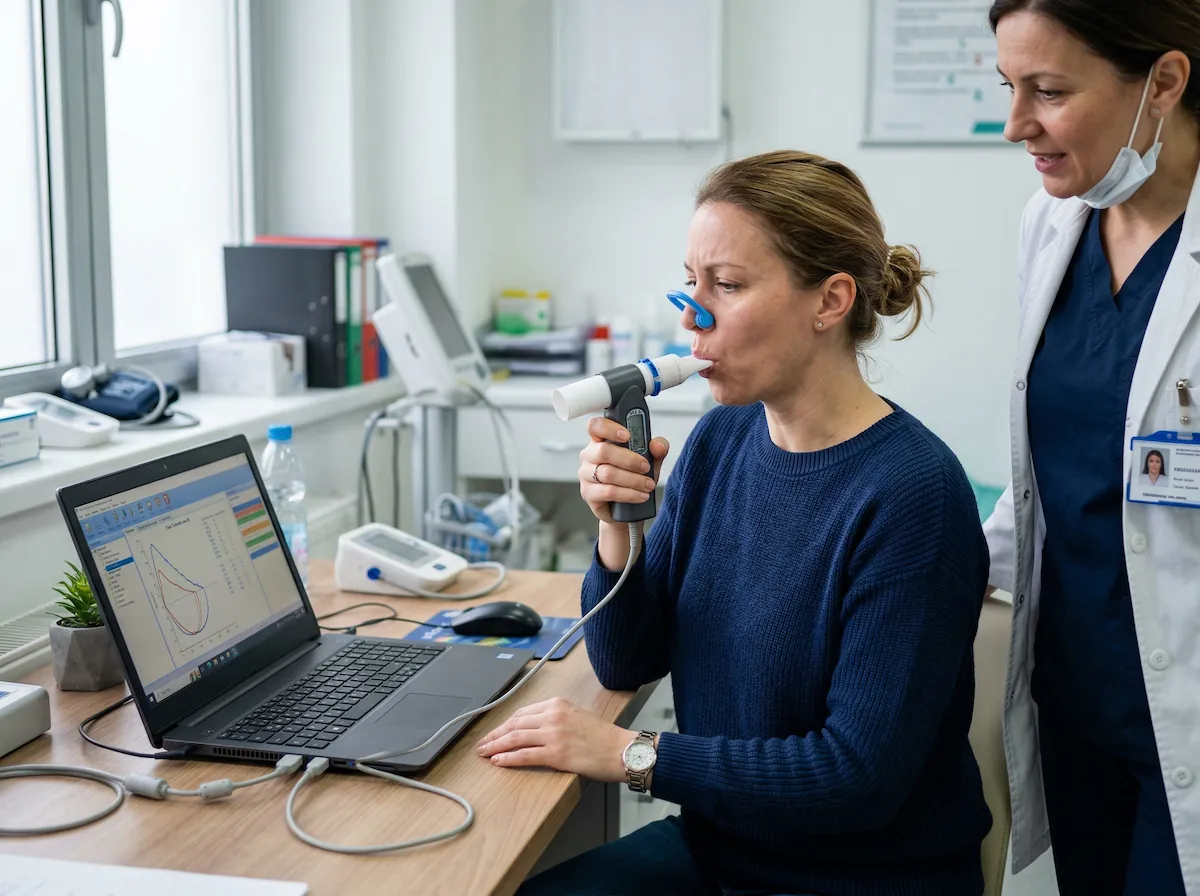
- The test itself — A soft clip will be placed on your nose to ensure all air flows through your mouth. You will breathe into a mouthpiece attached to a spirometer. You will be asked to take the deepest breath you can, then blow out as hard and fast as possible until your lungs are completely empty. This effort is repeated at least three times to ensure consistency and accuracy.
- Bronchodilator reversibility (if applicable) — If your initial results suggest airway obstruction, you may be given a quick-acting inhaled bronchodilator. After waiting about 15 minutes for the medication to take effect, the test is repeated to see whether your airflow improves.
- Results — Your spirometry results are available immediately. Milos Tomic, APRN will review the numbers with you, explain what they mean in plain language, and discuss any next steps — whether that is additional testing, a new diagnosis, or an adjustment to your current treatment plan.
- Asthma — to confirm the diagnosis, assess severity, and monitor how well your asthma is controlled over time
- COPD (chronic obstructive pulmonary disease) — to detect airflow obstruction, establish a baseline, and track disease progression
- Chronic bronchitis — to evaluate the degree of airway obstruction associated with ongoing inflammation
- Pre-operative evaluation — to assess your lung function before surgery, helping your surgical team plan for a safe procedure and recovery
- Occupational lung disease — to screen for airway damage caused by workplace exposures such as dust, chemicals, or fumes
- Unexplained shortness of breath or chronic cough — to determine whether an obstructive or restrictive lung pattern may be contributing to your symptoms
- Treatment monitoring — to measure whether your current medications and therapies are effectively improving your lung function
What to Expect During Your Spirometry Test
Spirometry is quick, non-invasive, and straightforward. Most appointments take about 15 to 20 minutes from start to finish. Here is what the experience looks like:
The test requires effort — you need to blow as hard and as long as you can — but it is not painful and involves no needles, no radiation, and no discomfort beyond a moment of exertion.
Conditions We Evaluate With Spirometry
Spirometry is an essential tool in diagnosing and managing many respiratory conditions, including:
Spirometry vs. Full Pulmonary Function Testing
You may wonder whether you need spirometry alone or a full pulmonary function test. Here is a simple way to think about it:
Spirometry is ideal when the clinical question is straightforward — for example, confirming an asthma diagnosis, screening for COPD, or checking how well your current treatment is working. It focuses on airflow and is the fastest way to get objective breathing data.
Full PFT is recommended when a more complete evaluation is needed — for example, when interstitial lung disease or pulmonary fibrosis is suspected, when lung volumes need to be measured, or when gas exchange (DLCO) must be assessed. Full PFT includes spirometry along with lung volume measurement and diffusion capacity testing.
Milos Tomic, APRN will recommend the appropriate test based on your symptoms, medical history, and clinical needs. In some cases, you may start with spirometry and proceed to full PFT if the initial results warrant a deeper evaluation.
Why Choose Advanced Pulmonary Care?
Milos Tomic, APRN, FNP-BC brings specialized training in pulmonary medicine combined with certification in acupuncture and Chinese herbal medicine — a combination that is rare in Connecticut and especially in the greater Manchester area. Patients receive unhurried, attentive visits where their concerns are genuinely heard.We accept all major insurance plans, including insurance coverage for spirometry. We see patients ages 12 and up and offer care in English, Serbian, Bosnian, Croatian, and Montenegrin. Our office is conveniently located at 175 Main Street, Suite B, Manchester, CT.