Sleep Studies in Manchester, CT — Answers Start with a Single Night
- Loud, persistent snoring
- Witnessed pauses in breathing or gasping during sleep
- Waking up feeling unrefreshed despite a full night in bed
- Excessive daytime sleepiness or fatigue
- Morning headaches or a dry, sore throat upon waking
- Difficulty concentrating or unexplained mood changes
Why a Sleep Study?
Many sleep problems are invisible during waking hours. You may feel exhausted every morning, struggle to stay alert during the day, or hear from your partner that you snore heavily or stop breathing at night — yet a routine checkup reveals nothing unusual. That is because the answers are hidden in what happens while you sleep.
A sleep study is a painless, non-invasive test that records your body’s activity overnight. It is the most reliable way to diagnose or rule out conditions like obstructive sleep apnea, central sleep apnea, and other sleep-related breathing disorders. If you are experiencing any of the following, a sleep study may be the right next step:
A sleep study gives us the objective data we need to understand exactly what is happening — and to build a treatment plan that works.
- Brain waves (EEG) — to identify sleep stages and arousals
- Eye movements (EOG) — to track REM and non-REM sleep cycles
- Muscle tone (EMG) — to detect movements and sleep-related muscle activity
- Heart rhythm (ECG) — to monitor cardiac activity throughout the night
- Breathing effort and airflow — to measure how well air moves in and out
- Oxygen saturation (SpO2) — to identify drops in blood oxygen
- Leg movements — to screen for periodic limb movement disorder
Types of Sleep Studies We Offer
In-Lab Polysomnography (PSG)
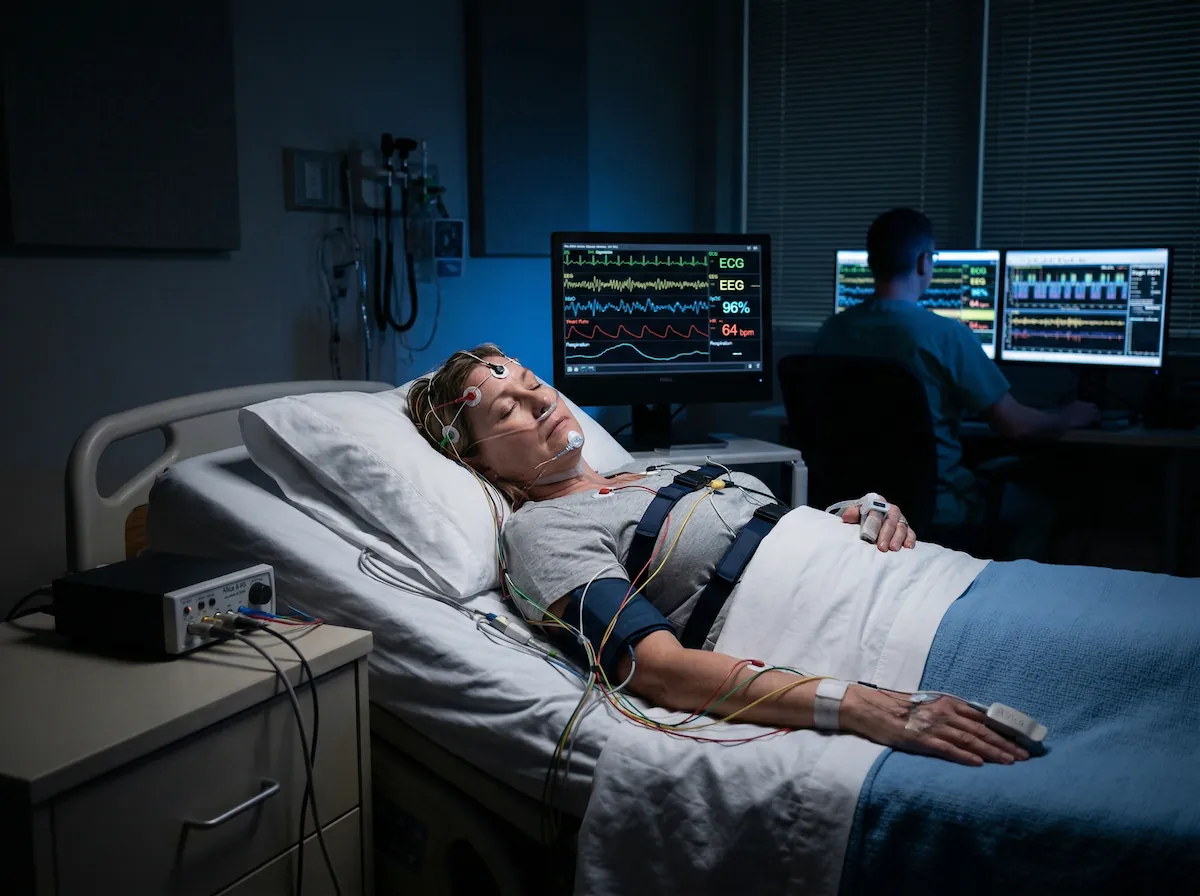
Polysomnography is the most comprehensive sleep study available. You spend one night at a sleep laboratory, where small sensors placed on your skin and scalp record a detailed picture of your sleep. The study monitors:
In-lab PSG is recommended when a more detailed evaluation is needed — for example, if central sleep apnea, narcolepsy, or other complex sleep disorders are suspected, or if a home test was inconclusive.
Home Sleep Testing (HST)
A home sleep test is a simpler, more convenient option for patients with a straightforward clinical picture of suspected obstructive sleep apnea. We provide you with a small portable device that you wear while sleeping in your own bed. The device measures airflow, breathing effort, oxygen saturation, and heart rate.
Home sleep testing works well when the primary question is whether obstructive sleep apnea is present and how severe it is. There is no need to spend a night away from home, and most patients find the device easy to use. We walk you through the setup before you take it home and are available if you have any questions.
Both in-lab and home sleep studies are covered by all major insurance plans when medically indicated.
What to Expect
For an in-lab study: You arrive at the sleep lab in the evening and settle in for the night. A technologist places small, painless sensors on your scalp, face, chest, and legs. You are free to read, watch television, or relax before falling asleep. The sensors do not restrict movement — most patients are able to shift positions and sleep in a way that feels reasonably natural. In the morning, the sensors are removed, and you go about your day.
For a home sleep test: During your office visit, we show you exactly how to apply the device and what to expect. That night, you attach the sensor, go to sleep in your own bed as usual, and return the device to our office the following day. That is all there is to it.
Neither test involves needles, sedation, or any discomfort. The goal is to capture a picture of your natural sleep, and the process is designed to be as straightforward as possible.
- Whether a sleep disorder such as obstructive sleep apnea is present
- The severity of the condition and how it is affecting your sleep and oxygen levels
- A recommended treatment plan tailored to your needs
What Happens After Your Sleep Study?
Once the data is collected, Milos Tomic, APRN personally reviews and interprets your results. You will be scheduled for a follow-up visit to discuss the findings in detail, including:
If sleep apnea is confirmed, your treatment plan may include CPAP or BiPAP therapy. We handle every step — from selecting the right device and pressure settings to fitting you with a comfortable mask and scheduling titration if needed. We also provide ongoing follow-up to make sure the therapy is working and that you are adjusting well.
Your results belong to you, and we take the time to explain them clearly so you understand exactly what is happening and why each recommendation is being made.
Why Choose Advanced Pulmonary Care?
Sleep studies are a core part of pulmonary medicine, and Milos Tomic, APRN has the specialized training to guide you from initial evaluation through diagnosis and treatment. At Advanced Pulmonary Care, you work directly with your provider at every step — there is no handoff to a separate sleep center without continuity of care.
We see patients ages 12 and up, accept all major insurance plans, and offer appointments in English, Serbian, Bosnian, Croatian, and Montenegrin. Our office is located at 175 Main Street, Suite B, Manchester, CT.
Ready to Breathe Better?
Join hundreds of patients who have found clarity and comfort through our integrative pulmonary care.