Pulmonary Function Testing (PFT) in Manchester, CT — A Complete Picture of Your Lung Health
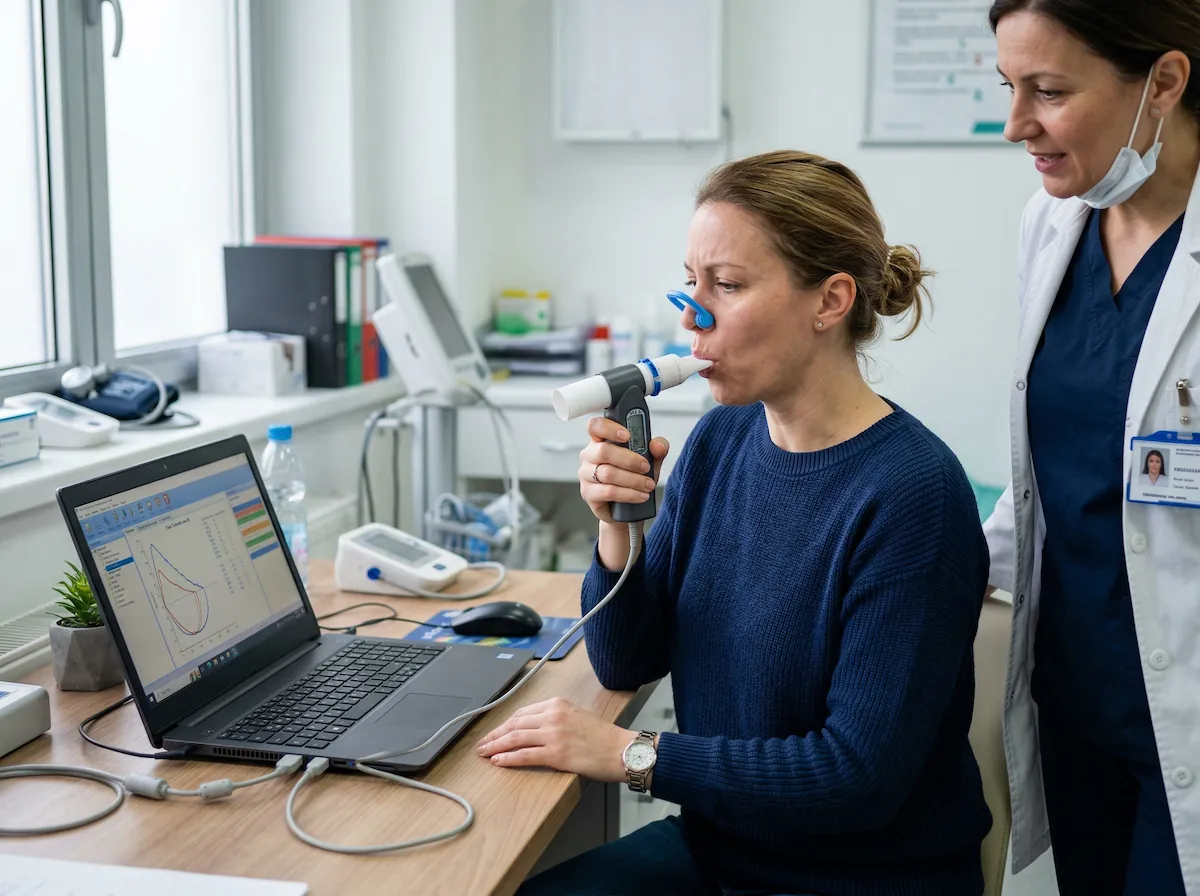
What Is Pulmonary Function Testing?
- Spirometry — measures how much air you can inhale and exhale and how quickly you can push air out of your lungs. This is the foundation of any lung function evaluation.
- Lung volume measurement (plethysmography) — determines the total amount of air your lungs can hold, including the air that remains after you exhale fully. This helps identify whether your lungs are restricted or hyperinflated.
- Diffusion capacity (DLCO) — measures how efficiently oxygen passes from the air sacs in your lungs into your bloodstream. A reduced DLCO can signal damage to the lung tissue or blood vessels within the lungs.
What Does Pulmonary Function Testing Measure
A full PFT session at our office typically includes three core components:
Together, these tests provide a complete picture of your respiratory system that no single test can offer on its own.
- Arrival and preparation — You will be seated comfortably. Our team will explain each test before it begins. You may be asked to avoid using inhalers for a set period before your appointment, and we will let you know ahead of time if any preparation is needed.
- Spirometry — You will breathe into a mouthpiece connected to a device called a spirometer. You will be asked to take a deep breath in and then blow out as hard and fast as you can. This is repeated several times to ensure accurate results.
- Lung volume measurement — You will sit inside a small, clear-walled booth (a body plethysmograph) and breathe gently through a mouthpiece. The booth is open and well-lit, and the test takes only a few minutes.
- Diffusion capacity (DLCO) — You will inhale a small, harmless amount of a tracer gas, hold your breath briefly, and then exhale. This test measures how well gases move across your lung membranes.
- Completion — The entire session typically takes about 30 to 45 minutes. Results are reviewed by Milos Tomic, APRN and discussed with you at your follow-up appointment.
What to Expect During Your Pulmonary Function Test
PFT is entirely non-invasive, requires no needles, and involves no pain. Here is what your visit will look like:
There is no recovery time needed. You can drive yourself to and from the appointment and return to your normal activities immediately.
- COPD (chronic obstructive pulmonary disease) — to confirm the diagnosis, determine severity, and track changes over time
- Asthma — to assess airflow obstruction and measure response to treatment
- Interstitial lung disease and pulmonary fibrosis — to detect restrictive patterns and reduced gas exchange
- Occupational and environmental lung disease — to evaluate lung damage from workplace or environmental exposures
- Pre-operative evaluation — to assess lung function before surgery, particularly chest or abdominal procedures
- Unexplained shortness of breath — to help identify the cause when the reason is not yet clear
- Chronic cough — to rule out or confirm an underlying pulmonary cause
Conditions We Evaluate With Pulmonary Function Testing
PFT plays a key role in diagnosing and monitoring a wide range of lung conditions, including:
Why Choose Advanced Pulmonary Care?
Milos Tomic, APRN, FNP-BC brings specialized training in pulmonary medicine combined with certification in acupuncture and Chinese herbal medicine — a combination that is rare in Connecticut and especially in the greater Manchester area. Patients receive unhurried, attentive visits where their concerns are genuinely heard.
We accept all major insurance plans, including insurance coverage for pulmonary function testing. We see patients ages 12 and up and offer care in English, Serbian, Bosnian, Croatian, and Montenegrin. Our office is conveniently located at 175 Main Street, Suite B, Manchester, CT.
Ready to Breathe Better?
Join hundreds of patients who have found clarity and comfort through our integrative pulmonary care.